
Study Policy
Australia's 2027 International Student Allocations: University Numbers and Current Visa Priority Status
Australia's 2027 National Planning Level remains 295,000. Higher education provider allocations are now available, while 75% of the 2026 system-wide allocation was linked to current or future students with visas as at 14 August. Provider priority affects offshore processing order, not approval prospects.
Australia has published indicative 2027 New Overseas Student Commencement (NOSC) allocations for higher education providers. A separate weekly PRISMS report shows each provider's current visa processing priority against its 2026 indicative allocation. Read together, the documents help offshore applicants plan timing, but neither can establish whether an individual visa will be granted.
The 2027 National Planning Level remains 295,000
| Category | 2027 places |
|---|---|
| National Planning Level | 295,000 |
| Public-university higher education | 161,725 |
| Other higher education providers | 38,500 |
| Remaining settings | Include VET and other components allocated by the responsible departments |
The overall level is unchanged from 2026. Public universities retain their 2026 higher education allocations, while VET students at public universities will be exempt from the 2027 NPL. Allocations for other higher education providers place greater weight on recent activity and give more favourable weight to offshore recruitment. The minimum allocation for an active provider remains 50 NOSCs.
Which public universities have the largest 2027 allocations?
| Provider | NOSC allocation |
|---|---|
| The University of Sydney | 11,900 |
| Monash University | 11,300 |
| The University of Melbourne | 10,500 |
| The University of New South Wales | 10,350 |
| The University of Queensland | 8,050 |
| Royal Melbourne Institute of Technology | 7,700 |
| Adelaide University | 7,350 |
| Deakin University | 6,550 |
| University of Technology Sydney | 5,350 |
| Macquarie University | 5,250 |
In Western Australia, the listed allocations are 4,100 for Curtin University, 3,900 for Murdoch University, 3,700 for Edith Cowan University and 3,550 for The University of Western Australia. These are NOSC reference figures used in managed growth and visa prioritisation. They are not total international enrolment caps or course-by-course places.
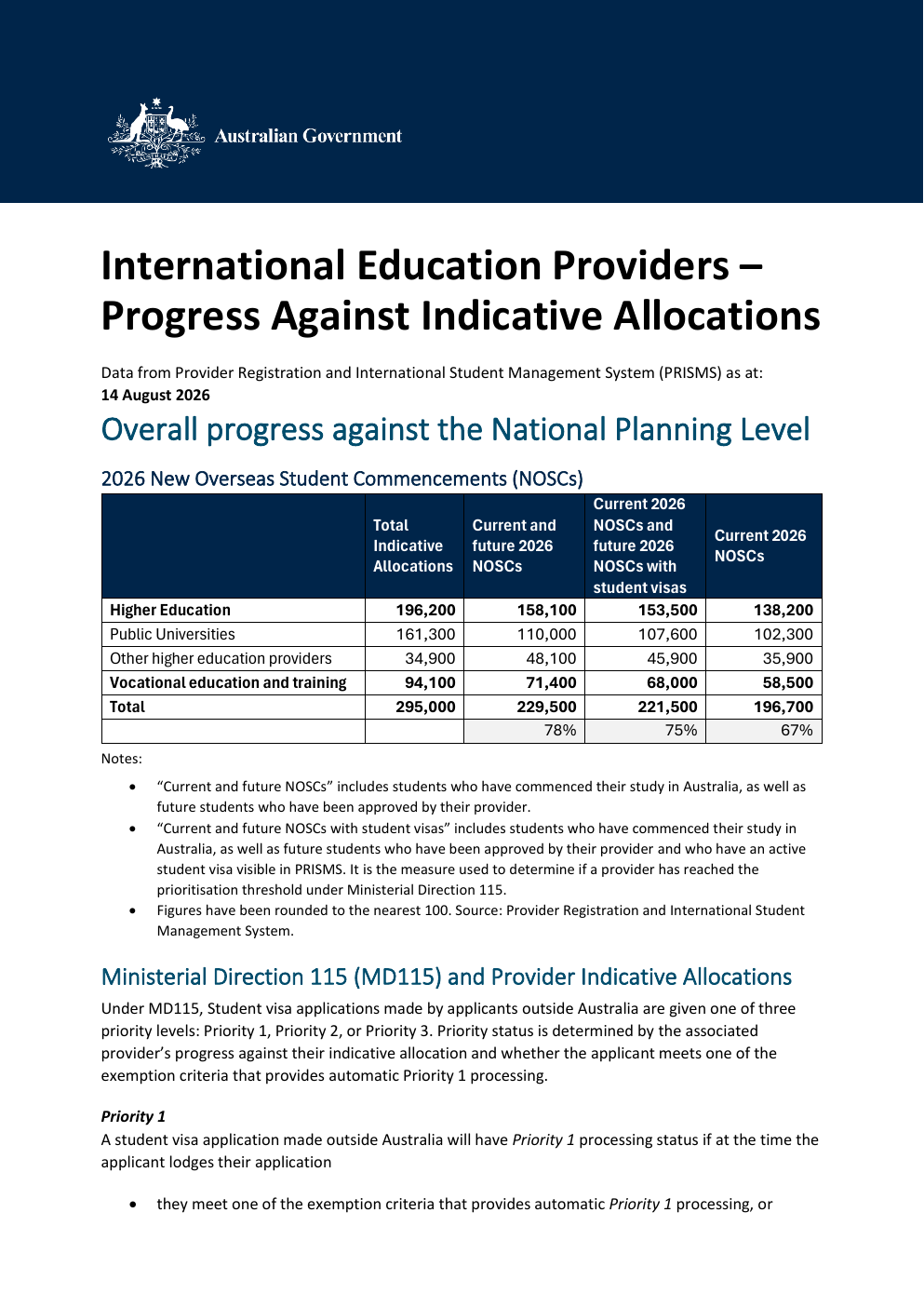
System progress as at 14 August
| Category | Allocation | Current and future | With student visas | Commenced |
|---|---|---|---|---|
| Higher education | 196,200 | 158,100 | 153,500 | 138,200 |
| Public universities | 161,300 | 110,000 | 107,600 | 102,300 |
| Other higher education | 34,900 | 48,100 | 45,900 | 35,900 |
| VET | 94,100 | 71,400 | 68,000 | 58,500 |
| Total | 295,000 | 229,500 (78%) | 221,500 (75%) | 196,700 (67%) |
The threshold measure is current and future NOSCs with an active student visa visible in PRISMS, rather than commenced students alone. Other higher education providers collectively exceed their aggregate indicative allocation, but an individual application is assessed by the associated provider's status and any applicable exemption.
How Priority 1, 2 and 3 work
| Priority | General offshore position | Practical effect |
|---|---|---|
| Priority 1 | Provider is below 80%, or an automatic exemption applies | Higher processing priority |
| Priority 2 | Provider is at least 80% but below 115%, with no exemption | Middle processing priority |
| Priority 3 | Provider is at least 115%, with no exemption | Lower processing priority; allow more time |
As at 14 August, Edith Cowan University, Monash University, The University of Melbourne, UNSW and The University of Sydney were Priority 2. Curtin, Murdoch, UWA, ANU, UQ, QUT, RMIT and UTS remained Priority 1. No public university was listed at Priority 3, although numerous other higher education providers were. The report is expected to change weekly, so status should be rechecked close to lodgement.
Who receives Priority 1 regardless of provider progress?
- school, non-award and standalone ELICOS students;
- students with a TAFE provider and students in pilot training courses;
- postgraduate research students;
- specified government-sponsored, Defence and Foreign Affairs students;
- students from Pacific countries and Timor-Leste;
- students in specified transnational education arrangements.
What should a prospective 2027 student do?
- Identify the actual CRICOS-registered provider, not only the trading brand;
- check the latest weekly provider status close to visa lodgement;
- allow extra time where the provider is Priority 2 or 3;
- do not treat Priority 3 as a refusal prediction or Priority 1 as a reason to weaken Genuine Student, financial, English or other evidence;
- do not subtract the 2026 weekly figures from the separate 2027 allocations as though they were the same reporting year.