
Skilled & State Nomination
ACT's opening 2026–27 round: 261 subclass 190 invitations and occupation Matrix scores
ACT issued 54 doctorate streamlined, 18 small business, 126 Canberra critical skills and 63 offshore critical skills invitations. All were for subclass 190. Canberra Matrix rankings are separate from federal EOI points.
The ACT Government has published the results of its 12 October 2026 nomination invitation round, the opening round in its tentative 2026–27 schedule. Four applicant categories received a combined 261 invitations for subclass 190, with none for subclass 491. Applicants can now compare an actual round result, rather than a proposed date, against their residence category, occupation group and Matrix submission timing.
The invitation breakdown
| Official category | 190 invitations | 491 invitations |
|---|---|---|
| Doctorate Streamlined Pathway | 54 | 0 |
| Canberra residents: Small Business Owners | 18 | 0 |
| Canberra residents: Critical Skill Occupations | 126 | 0 |
| Overseas applicants: Critical Skill Occupations | 63 | 0 |
| Total | 261 | 0 |
The small business owner category had a minimum 190 Matrix ranking score of 120. The doctorate category is reported separately: its 54 invitations are not an occupation-specific count, and the published result does not split that category into onshore and offshore numbers.
These are invitations to apply for ACT nomination, not nomination approvals or visa grants. Subclass 491 received zero invitations in this round. N/A in the 491 ranking columns means those Matrices were not considered; it is neither a zero-point threshold nor confirmation that the 491 pathway has permanently closed.
Selected nursing, accounting, IT and education rankings
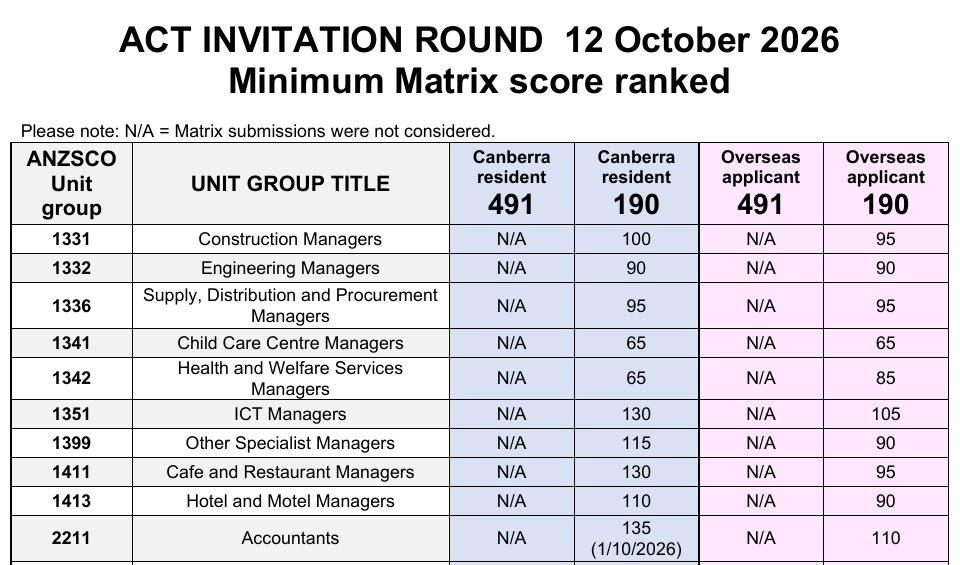
The official table separates Canberra residents and overseas applicants by ANZSCO unit group. Different rankings can apply to the same occupation depending on the applicant category. The selection below covers common enquiry areas; all 105 published groups are retained in the ACT guide's dated invitation archive.
| ANZSCO group | Occupation group | Canberra resident 190 | Overseas applicant 190 |
|---|---|---|---|
| 2211 | Accountants | 135 (1/10/2026) | 110 |
| 2332 | Civil Engineering Professionals | 115 | 90 |
| 2411 | Early Childhood (Pre-primary School) Teachers | 130 (24/8/2026) | 80 |
| 2414 | Secondary School Teachers | 90 | 90 |
| 2544 | Registered Nurses | 115 | 80 |
| 2611 | ICT Business and Systems Analysts | 140 | 120 |
| 2613 | Software and Applications Programmers | 130 (7/9/2026) | 105 |
| 2725 | Social Workers | 85 | 80 |
| 3312 | Carpenters and Joiners | 100 | 95 |
| 3411 | Electricians | 90 | 90 |
| 3513 | Chefs | 125 | 90 |
Registered Nurses ranked at 115 for Canberra residents and 80 offshore. Early Childhood Teachers ranked at 130 and 80, while Accountants ranked at 135 and 110. IT also differs by group: ICT Business and Systems Analysts ranked at 140 and 120, compared with 130 and 105 for Software and Applications Programmers. Broad labels such as healthcare or IT are not substitutes for checking the actual unit group.
Read the score and submission date together
Federal EOI points and Canberra Matrix scores serve different purposes. EOI points relate to the federal skilled migration points test; Matrix ranks candidates within ACT's nomination process. A figure such as 65, 80, 115 or 135 in this ranking table must not be described as a federal subclass 190 EOI invitation threshold.
Some results include a parenthesised date: Accountants 135 (1/10/2026), Early Childhood Teachers 130 (24/8/2026), and Software and Applications Programmers 130 (7/9/2026). ACT states that remaining places, submission date and time, occupation caps and demand affect selection. Comparing scores alone can therefore miss a material difference between otherwise similarly ranked applicants. Where the table gives only a date, no unpublished timestamp or extra selection rule should be inferred.
ACT warns that a minimum ranking score does not guarantee an invitation. An active application or a previous ACT nomination can also affect further invitation access. Personal circumstances such as visa expiry or a critical birthday are not grounds for promised priority selection.
Future dates and the annual allocation
As checked on 14 October, later tentative rounds are scheduled for the weeks commencing 25 January, 22 March and 24 May 2027. They remain subject to final allocations and operational requirements, so they are not guaranteed invitation dates.
The ACT page still says the 2026–27 annual allocation has not been announced. The previous year's figures of 800 places for each subclass must not be reused as this year's allocation. Nor should 261 invitations be treated as the number of nomination places available for the entire year.
Preparing after the round
Invited applicants should follow the deadline in their own notice and check evidence supporting residence, employment, English, qualifications and other Matrix claims at the submission date. Applicants still waiting should first identify the correct residence category, occupation group and submission timing. This result is a historical reference, not a forecast of the next round or an assurance of individual success.
For an ACT planning review, contact XIVisa on WeChat at xivisa1 with your location, occupation and ANZSCO code, EOI and Matrix scores, Matrix submission date, visa expiry and relevant work or study background. These details help identify the requirements and evidence needing review. We do not promise invitations, nomination approvals or visa outcomes. This article provides general information only.
Discuss your plans on WeChat
Add XIVisa on WeChat: xivisa1. Mention the article you read and briefly describe your current visa, location and plans so we can understand your enquiry. Please do not send passport numbers or other sensitive documents in your first message.
WeChat:xivisa1