
Migration Policy
MD119 historical rules: replaced by MD121 and MD122 on 19 September 2026
This is a historical record of MD119. MD121 and MD122 replaced it on 19 September 2026, so current applications no longer follow the old five-level order described here.
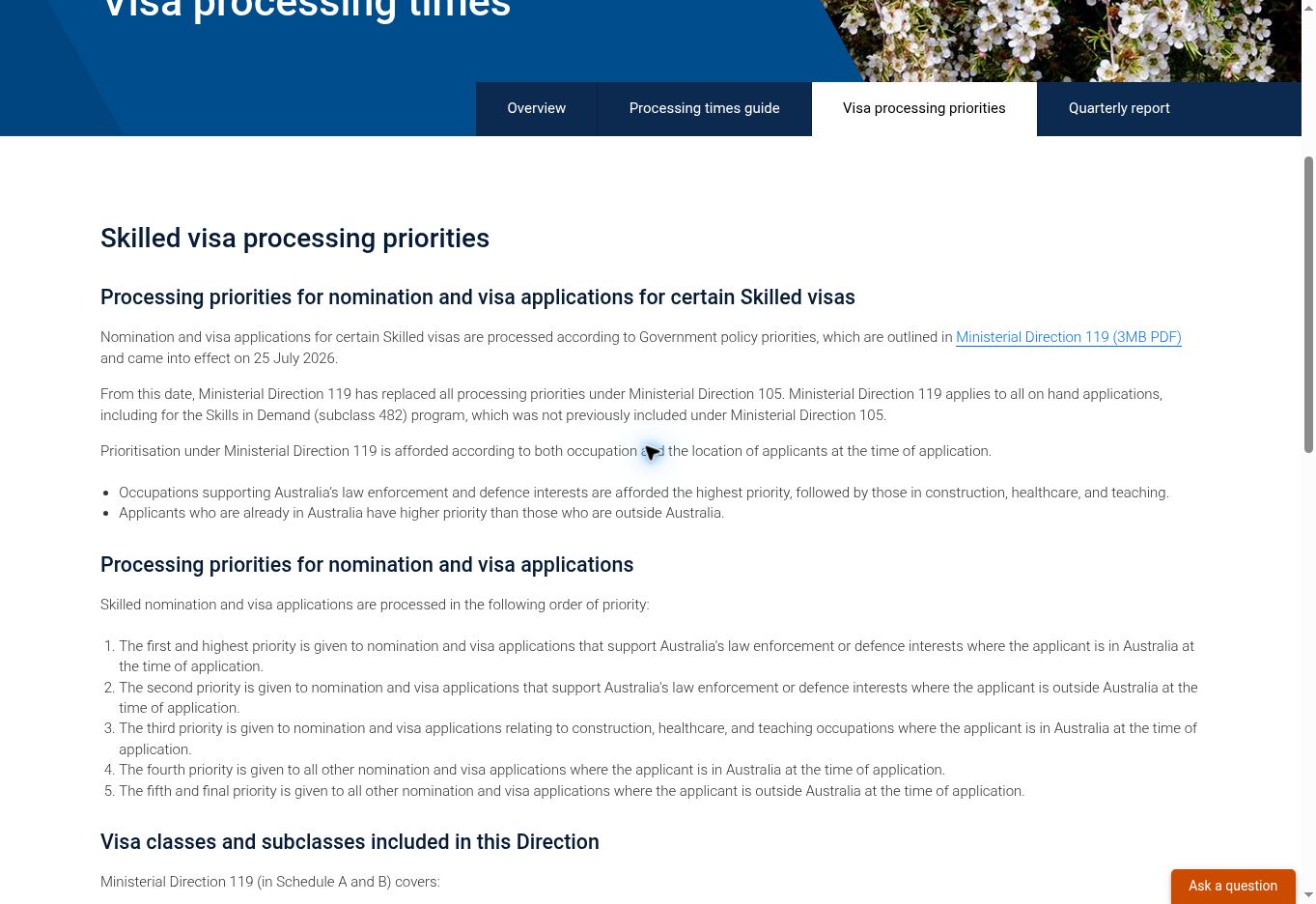
Australia’s new Ministerial Direction 119 took effect on 25 July 2026. It replaced Ministerial Direction 105 and resets the order in which certain skilled and employer-sponsored visa matters are processed.
The Direction applies to applications not finally determined at commencement and to new applications lodged from that date. The Skills in Demand subclass 482 program is now expressly included.
Two factors that determine processing priority
Priority is primarily determined by the nominated occupation and whether the primary applicant or nominee was in or outside Australia when the relevant application was lodged. Later travel generally does not change the priority fixed at lodgement.
The five processing priority levels
- First: law enforcement or defence-related applications where the applicant or nominee was in Australia at lodgement.
- Second: law enforcement or defence-related applications where the applicant or nominee was outside Australia at lodgement.
- Third: applications relating to specified construction, healthcare or teaching occupations where the applicant or nominee was in Australia at lodgement.
- Fourth: all other relevant applications where the applicant or nominee was in Australia at lodgement.
- Fifth: all other relevant applications where the applicant or nominee was outside Australia at lodgement.
Which visas are covered?
- Subclass 186 Employer Nomination Scheme
- Subclass 187 Regional Sponsored Migration Scheme legacy applications
- Subclasses 189 and 190
- Subclass 191
- Subclass 482 Skills in Demand and legacy TSS applications
- Legacy subclass 489
- Subclasses 491 and 494
- Subclasses 887 and 888
For employer nominations, the Direction covers nomination applications associated with subclasses 186, 187, 482 and 494.
Which construction, healthcare and teaching occupations receive priority?
The Direction uses identified ANZSCO groups and occupation codes, not broad industry labels. It includes specified construction managers, architects, civil engineering professionals, building trades, welders, plant operators and electricians; identified health professional, support and care occupations; and specified school, early-childhood, vocational and university teaching occupations.
Working in a related industry does not by itself establish priority. The nominated occupation must be checked against the ANZSCO groups or codes stated in Direction 119.
Do regional positions and accredited sponsors retain separate priority?
The five-level order no longer lists a regional position or accredited sponsor status as a separate priority category. Occupation and location at lodgement are now the central factors. This does not change regional visa eligibility, concessions or visa effect, but it may change a matter’s place in the processing queue.
Important exceptions
- Applications remitted by the AAT or ART for reconsideration;
- matters where the AAT or ART set aside a decision and substituted a new decision;
- applications that readily appear unable to satisfy the relevant criteria;
- certain subsequent family-member applications not combined with the primary application;
- nomination applications involving a change of employer;
- the ART itself.
Family members included in a combined application generally receive the same priority as the primary applicant.
Processing priority does not relax eligibility requirements
XIVisa reminder
Applicants and employers considering subclass 482 or 186 should not choose onshore lodgement based on processing speed alone. Current visa status and conditions, lawful stay, bridging visa arrangements and onshore lodgement eligibility all require consideration. Offshore applications continue to be processed and eligible applicants may continue to lodge them.